Ethnodeterminism

Today we are going to something you’ve maybe never done before. We’re going to use a little bit of racism to help us decode history.
This is no ordinary racism. This is powerful stuff.
With racism this potent you can see things hidden since the beginning of the world.
The lens through which you are about to see the world is called ethnodeterminism. What the great men of the past saw through a glass darkly, we can now see clearly overlays the schisms of history.
Despite propaganda insinuating otherwise, there are great families of men. We can, and we have, tracked these families patrilineally across time. One stands apart.
The most recent human evolution on the Y Chromosome, Y Haplogroup R1b, is associated with a unique form of human association. Patriarchy. Hero worship. A form of government Caryle referred to as Heroarchy. This form of human association created the necessary preconditions for the creation of the modern world - admiration and celebration of great men rather than jealous imitation.
For whatever reason, one group of humans seems to have evolved an ability to escape the prison of mimetic resentment and the burden of its attendant mimetic crisis—concepts outlined by Sigmund Freud and René Girard in their extraordinary interpretations of the heart-stopping research on comparative religion by James George Frazer.
The fundamental insight from these 20th-century thinkers is that the quality which allowed man to thrive, mimicry, a desire to emulate others, is also paradoxically his own undoing. Mimicry leads to jealousy. Jealousy leads to resentment. Resentment leads to murder; murder of the fittest.
Religious ceremonies simulating the catharsis of a murder resentment through either convergent evolution or cultural continuity became a near human universal. Through recurring rituals of actual or simulated murder, often a murder of the king, the community could be unburned of the prison of their own debilitating resentment for a time and therefore freed to continue to cooperate for mutual benefit.
But for every rule there is an exception. One human group, perhaps somehow less mimetic or less interested in emulating the behavior of others — a quality generally described as individualism — appears to have escaped the trap of mimetic crisis. Paradoxically those human groups who are more individualistic appear to be more able form mutually beneficial societal structures. This is almost certainly a result of their ability to tolerate or even celebrate hierarchy, a cultural technology which Xunzi notes allows humans to collectively become more capable than even great beasts.
This stark and important cultural difference— which can be traced genetically— is best represented by the following axiom: If you are a human, every winter you either celebrate the birth of a King or the death of a King.
Tracing the line of Kings
Have you ever noticed similarities between the fall of Rome and present day America? Did you know they have almost identical Y Haplogroup profiles over time?
In the case of both America and Rome, you have a founder population with a very high percentage of the male lineage Y haplogroup R1b, which we are going to refer to as the “line of Kings” for clarity. Then, as both Rome and America flourished they attracted immigrants to them and in so doing reduced the relative concentration of men born from the line of Kings. Absent the ubiquity of that peculiar sensibility held by their founders both Rome and America transformed from societies that revered Kings to societies that resented them.
In the case of America we can trace with a great deal of accuracy the emergence of a politics of resentment that is perfectly coincident with immigration from populations with low levels of Y Haplogroup R1b. From the 1890s to 1920’s America received its first wave of immigration from populations outside of Northwestern Europe, the so called Ellis Islanders. By the 1930’s America had a New Deal reflecting the jealous sensibilities of its new polity. To this day we can see American “Party” politics are split generally along the lines of the frequency of the of the male lineage common to the founders of Rome and America, the line of Kings. The concentration of this male lineage is lowest in metropolitan areas, which are dominated by the politics of resentment, and highest in regions outside of the cities, where prosocial hierarchies are preferred.
In the case of Rome, their story ended when they were defeated by highly coordinated war bands from Northwest Europe whose men were primarily descended from the line of Kings.
Protestantism as an Ethnoreligious Revolt
After the fall of the Roman Empire there were a series of principalities that were not the Roman Empire but which referred to themselves as such. Thiel’s rule that disciplines which refer to themselves as “science” (climate science, political science) are the least likely to resemble actual science (physics, chemistry) seems to apply here too.
A much better name for the meta-organizational structure in this case would be Christendom. The degree to which individual states were or were not controlled by the central authority of the Church in Rome constitutes the bulk of European history after the fall of Rome. For roughly 1000 years Europe was united under the banner of Christendom. Then it fell apart. Why?
Thomas Babington Macaulay describes the reformation through an ethnodeterminist lens using language as a proxy for gene in his 1848 A History of England:
“The Reformation had been a national as well as a moral revolt. It had been, not only an insurrection of the laity against the clergy, but also an insurrection of all the branches of the great German race against an alien domination. It is a most significant circumstance that no large society of which the tongue is not Teutonic has ever turned Protestant, and that, wherever a language derived from that of ancient Rome is spoken, the religion of modern Rome to this day prevails.”
The linguistic division Macaulay identifies in Christian Europe can be better and more completely understood by modern genomics. The Protestant Reformation not only split Europe along linguistic lines, it split Europe along genetic lines. Nowhere is this genetic differentiation more easily discerned than by measuring Y Haplogroup frequency. Which is to say, where we observe the male paternal lineage of the line of Kings, we also observe a preference to acclaim a King over the bureaucracy of the Church; and the reverse is also true. Wherever we see an absence of the line of Kings we see a preference for bureaucratic social organization, which is itself a result of a negative preference for Kings.
Lets compare a map of Y Haplogroup R1b frequency, the percentage of men who carry the male lineage associated for thousands of years with the formation of prosocial hierarchy, to the spread of Protestantism in Europe.


What you will notice is that the frequency of Y Haplogroup R1b—the line of Kings—not only aligns strongly with the countries that became Protestant, but it also strongly correlates with resistance to Church bureaucracy within countries: Trastámara Spanish nationalism and resistance to Habsburg bureaucracy in the north of Spain; the Huguenots in France.
Viewed from the perspective of Y Haplogroup frequency, Florence too becomes not just another city in Italy but the frontier of the line of Kings in Europe. Most of the politics in that city likewise centered for centuries on the fundamental question of the supremacy of the Church or the State. Viewed from the perspective of Y Haplogroup frequency, we can see Machiavelli’s Florentine republic as a homogenous point of resistance against heterodox Church bureaucracy. Likewise, The Prince can be viewed as an acclamation of absolute hierarchy, the societal organization common to societies dominated by the line of Kings, written in the wake of a failure to install its alternative.
But if Christendom had functioned well enough as an organizational unit for centuries then what changed between the Fall of Rome and the beginning of the Protestant Reformation? Genes changed.
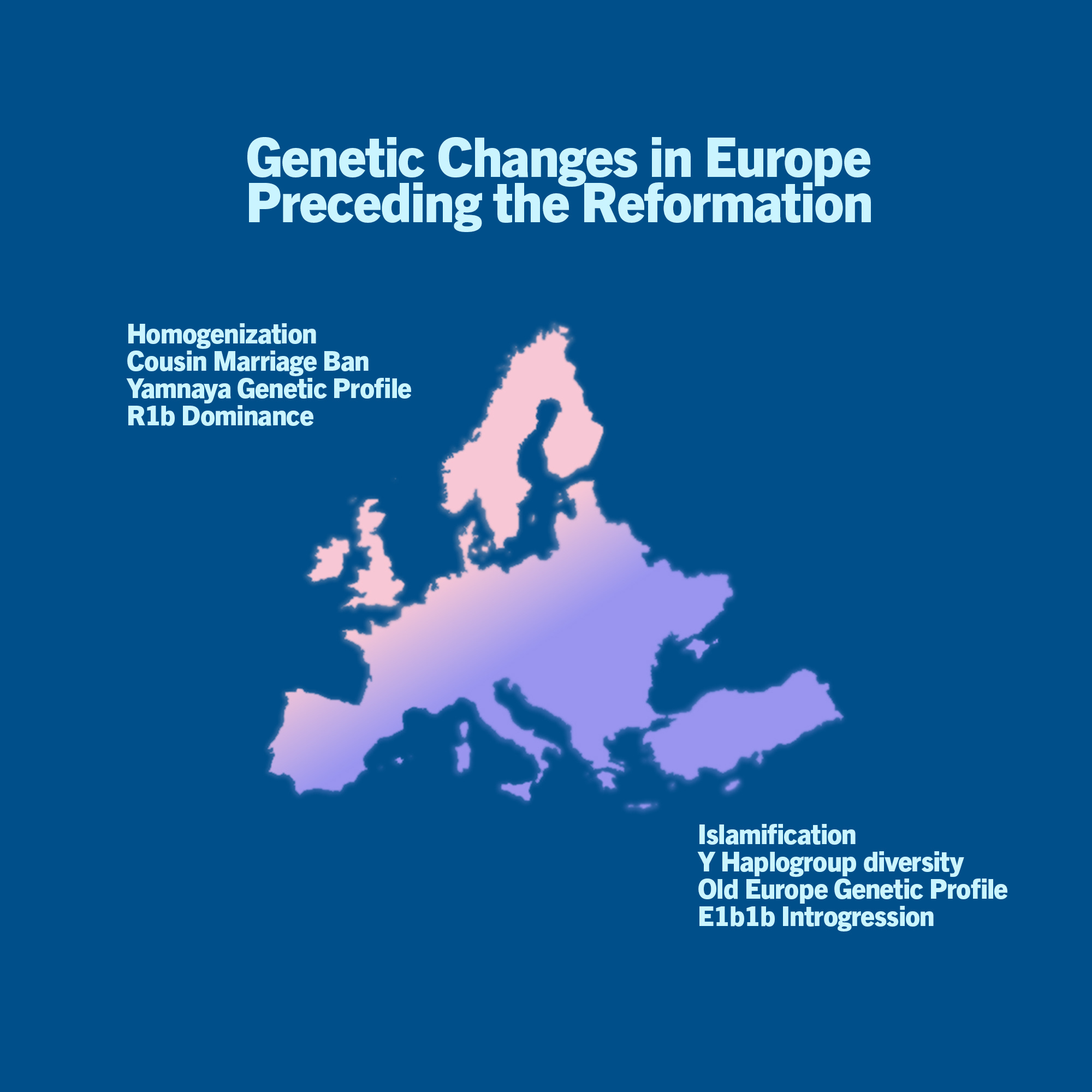
The Abbasid and Umayyad Caliphates left a lasting impact on the genetic profile of Southern Europe, especially in terms of Y Haplogroup frequencies. While in the North West of Europe strict laws against consanguineous marriage created a genetically homogeneous cohort. The effects of both of these centuries long genetic processes can still be seen today.
Northwest Europe in the centuries leading up to the Protestant Reformation became increasingly genetically distinct from southern and central Europe. This genetic distinction was both the cause of the Protestant Reformation and the source of the region’s success following the Reformation. Northwest Europeans, as a homogeneous and R1b-dominant group, were genetically suited to the adoption of the cultural technology of nested hierarchy, the kind that Machiavelli advocates for in The Prince. Whereas central and southern Europe, and the rest of the world for that matter, retained a genetic profile more consistent with the human universal: societies driven by resentment and mimetic desire which require ritual sacrifice of hierarchical figures— murder of the fittest— in order to function.
This is the fourth essay in an ongoing series on Genomics and Religion. You can find the rest of the series here:
Part 1: Genomics and Religion
Part 2: “No Kings”
Part 3: Prehistoric and Historic; Cthonic and Olympian
Part 4: Ethnodeterminism